Palaeozoic: western Iraq
Western Iraq lies on the stable Arabian Platform, where the Palaeozoic succession is relatively undeformed and thick. The region records Cambrian–Ordovician rifting and passive margin sedimentation, Silurian post-glacial transgression, Devonian–Carboniferous thermal subsidence, and Permian tectonic reactivation linked to the Neotethys opening.
Sources include Silurian hot shales (Qusaiba equivalent). Reservoirs include Ordovician Sandstones (e.g. Khabour Formation), Silurian–Devonian sandstones, and Carboniferous–Permian sandstones. Seals include Silurian shales that act as both source and regional seal, and Devonian and Carboniferous shales.
There are Palaeozoic structural traps like gentle anticlines and faulted blocks; also stratigraphic traps: pinch-outs, and unconformity traps beneath the Hercynian unconformity.
Two wells in the public domain are a useful guide to the palynostratigraphy of the Palaeozoic: KH (Key Hole)-5/1 (33°33'23'' 40°19'25‘’, drilled to 1,620m) and Akkas-1 (34°09'18.8'' 40°57'49.4‘’ drilled to 4,238m) (Fig. 1). KH-5/1 is unusual in being fully cored.
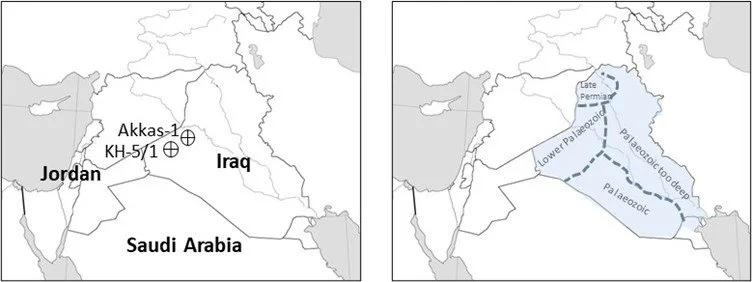
Fig. 1. KH-5/1 and Akkas-1 locations (after Stephenson et al. 2017) and the prospective Palaeozoic of Iraq, after Al-Hadidy, 2007
The wells penetrate thick sequences of Palaeozoic. Akkas-1, had shows in several Palaeozoic rock-units and made the Akkas field a light oil and gas discovery. KH-5/1 was drilled as a deep water well. KH-5/1 well section spans the Hercynian unconformity at 670 m depth with the Raha Formation below and the Ga’ara Formation above. The unconformity appears to be associated with non-deposition or erosion of rocks corresponding approximately in age to part of the Serpukhovian and Bashkirian (latest Mississippian to early Pennsylvanian).
A summary of the palynostratigraphy in this part of western Iraq is shown in Fig. 2.
Points to note.
· Palynostratigraphy of KH-5/1 is of high quality but extends only into the Mississippian (lower Carboniferous). Though the well TDs in Lower Paleozoic there appears to be no public domain palynology from this section. The palynology above and below the Hercynian unconformity is distinct. The presence of abundant monosaccate pollen is the easiest way to determine a post HU position.
· The palynostratigraphy of Akkas-1 is from numerous cores offering high quality data down to 4132m within the Khabour Formation. Palynostratigraphy appears to suggest that the Hercynian unconformity is not present Akkas-1.
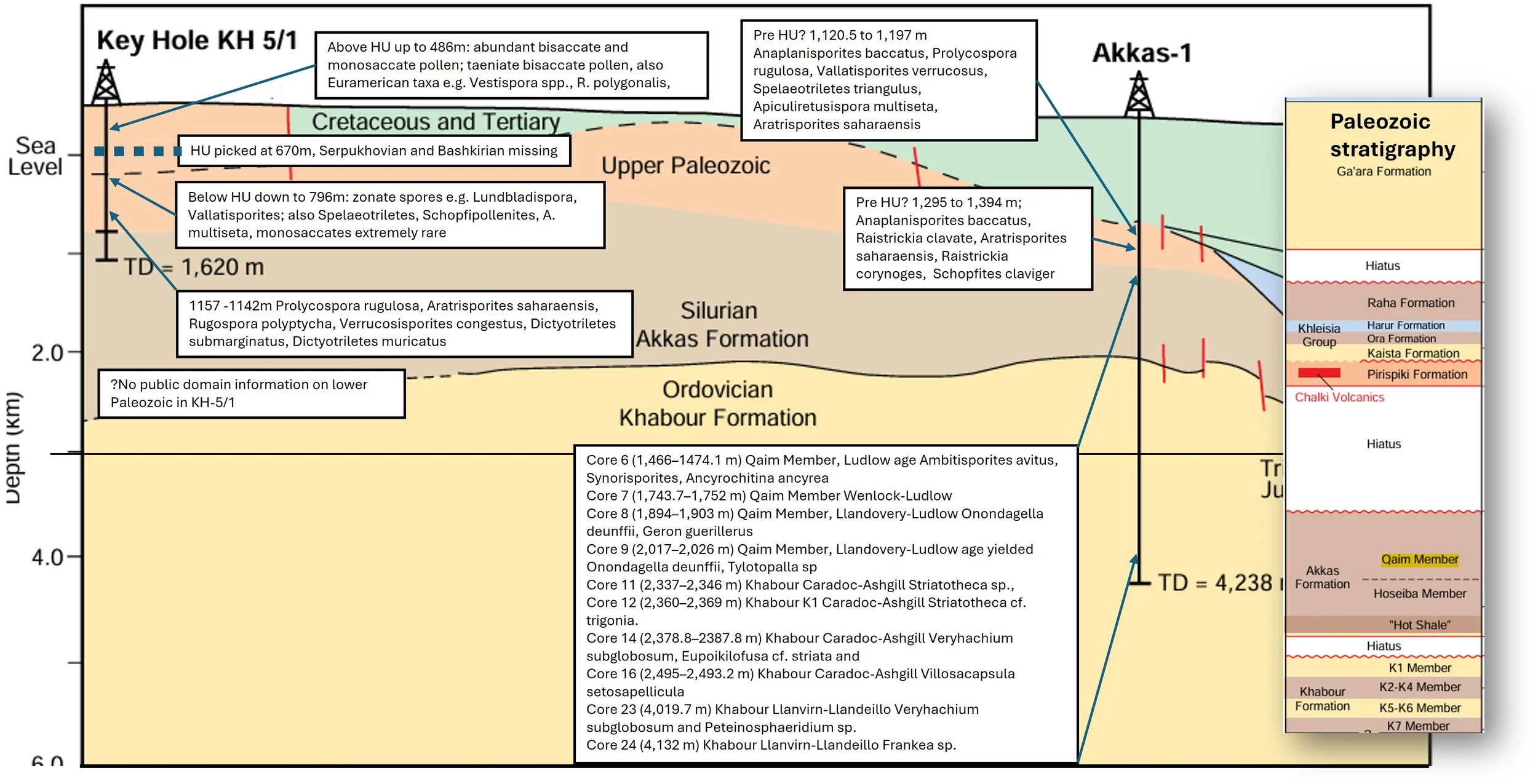
Fig. 2. Summary palynostratigraphy of KH-5/1 and Akkas-1. Palynology from Al-Hadidy 2007 and Stephenson et al. 2017. Modified from Al-Hadidy 2007
References
Al-Hadidy, A., 2007. Paleozoic stratigraphic lexicon and hydrocarbon habitat of Iraq. GeoArabia 12, 63–130.
Stephenson, M H, Kader Al-Mashaikie, S Z A, and Kurukchi, W M. 2016. Palynological assemblages across the Hercynian unconformity in Western Iraq. Revue de Micropaleontologie, 60, 417-432.
More detailed information is available from Mike Stephenson who is available for palynology consulting: mikepalyno@me.com