Disentangling temperature rise due to global warming and continental drift
The Late Palaeozoic Ice Age (LPIA), was one of Earth's most extensive and long-lasting glacial episodes, spanning roughly from 350 to 260 Ma. Northeastern and southeastern Gondwana both experienced the warming due to the final stages of the LPIA in the Asselian and Sakmarian (e.g. Montañez 2022, Jurikova et al. 2025) but the two parts of Gondwana experienced very different latitudinal drift: one moved rapidly north into lower latitudes, the other moved south into higher latitudes with the result that plant communities in the two areas developed very differently. The dynamic between temperature rise due to global warming and temperature rise due to continental drift needs careful consideration particularly in correlation and palaeoclimate studies.
Northeastern Gondwana (the part corresponding with modern Arabia) moved around 750 km north between 300 Ma and 280 Ma from around 48°S to 41°S. Modern coastal latitudinal temperature gradients range from 0.91 °C per 1° latitude (steepest) to 0.28°C per 1° latitude (weakest) indicating a mean of around 0.6°C per 1° latitude. This indicates a temperature rise purely due to northward drift (assuming similarity with modern conditions) of ~4°C. This northward movement coupled with LPIA temperature rise produced very marked changes in temperature and resulted in big changes in palaeovegetation (Stephenson et al. in review a).
Northward drift of northeastern Gondwana between 390 Ma and 220 Ma
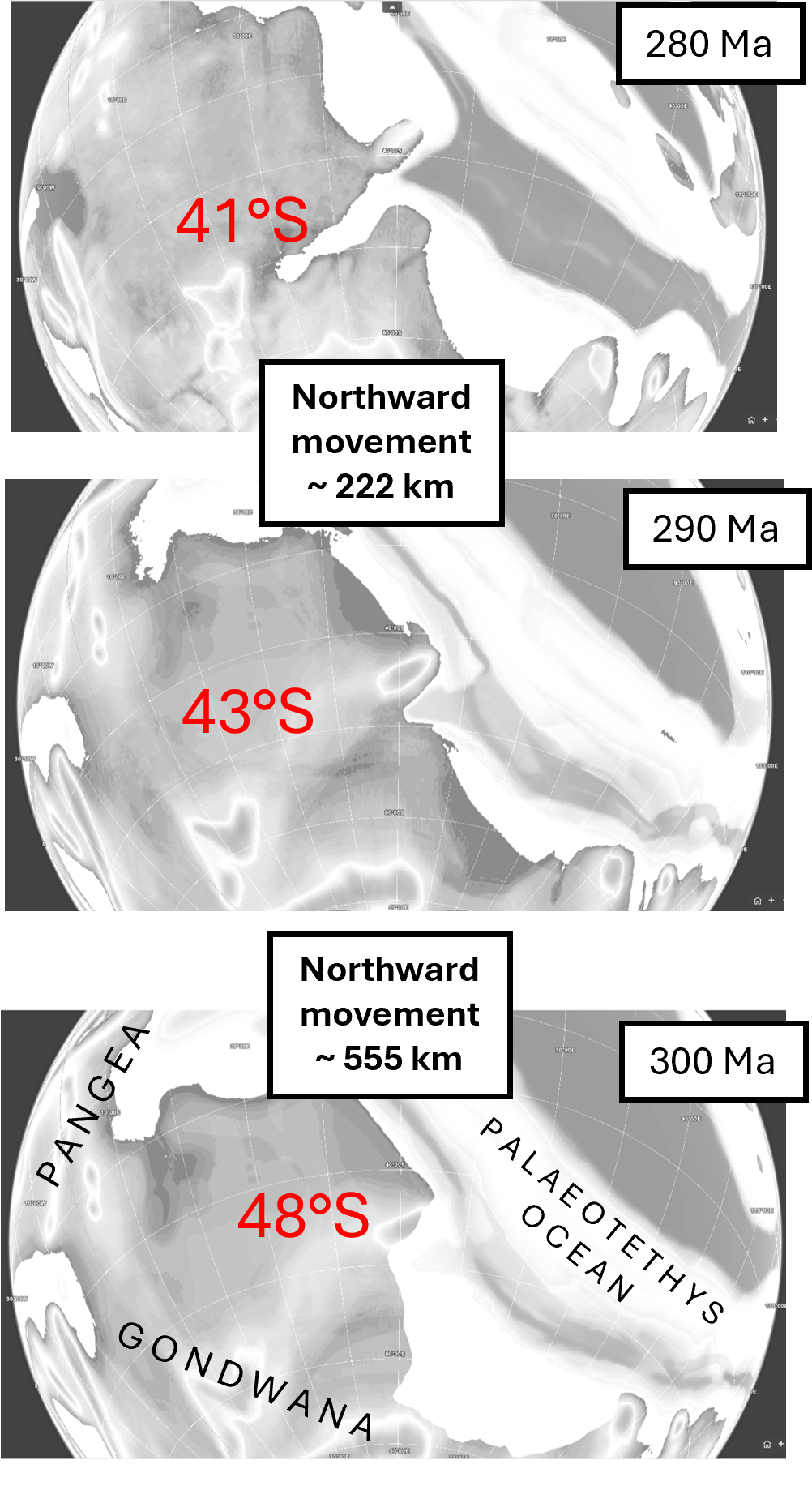
Northeastern Gondwana (the part corresponding with modern Arabia) moved around 750 km north between 300 Ma and 280 Ma from around 48°S to 41°S.
However southeastern Gondwana, in particular eastern Australia, was very different. It moved south to higher latitudes, from 70°S to 77°S between 300 Ma and 280Ma, so a temperature fall of ~4°C might be expected. Paleotemperature modelling might suggest a similar rise due to global warming, with the two approximately cancelling each other out. We could therefore hypothesize that palaeovegetation might stay approximately the same between 300 Ma and 280 Ma in eastern Australia given an approximately stable temperature.
A simple survey of the palynological characteristics of the Early Permian in eastern Australia (e.g. Laurie et al. 2016) indeed suggests that cheilocardioid spores such as Microbaculispora persist much longer into the Early Permian (into the late Artinskian) than in northeast Gondwana where such spores become very rare after the Asselian (Stephenson et al. in review b). It is noteworthy that cheilocardioid spores were produced by plants that are sensitive to temperature rise (e.g. see Stephenson et al. 2026).
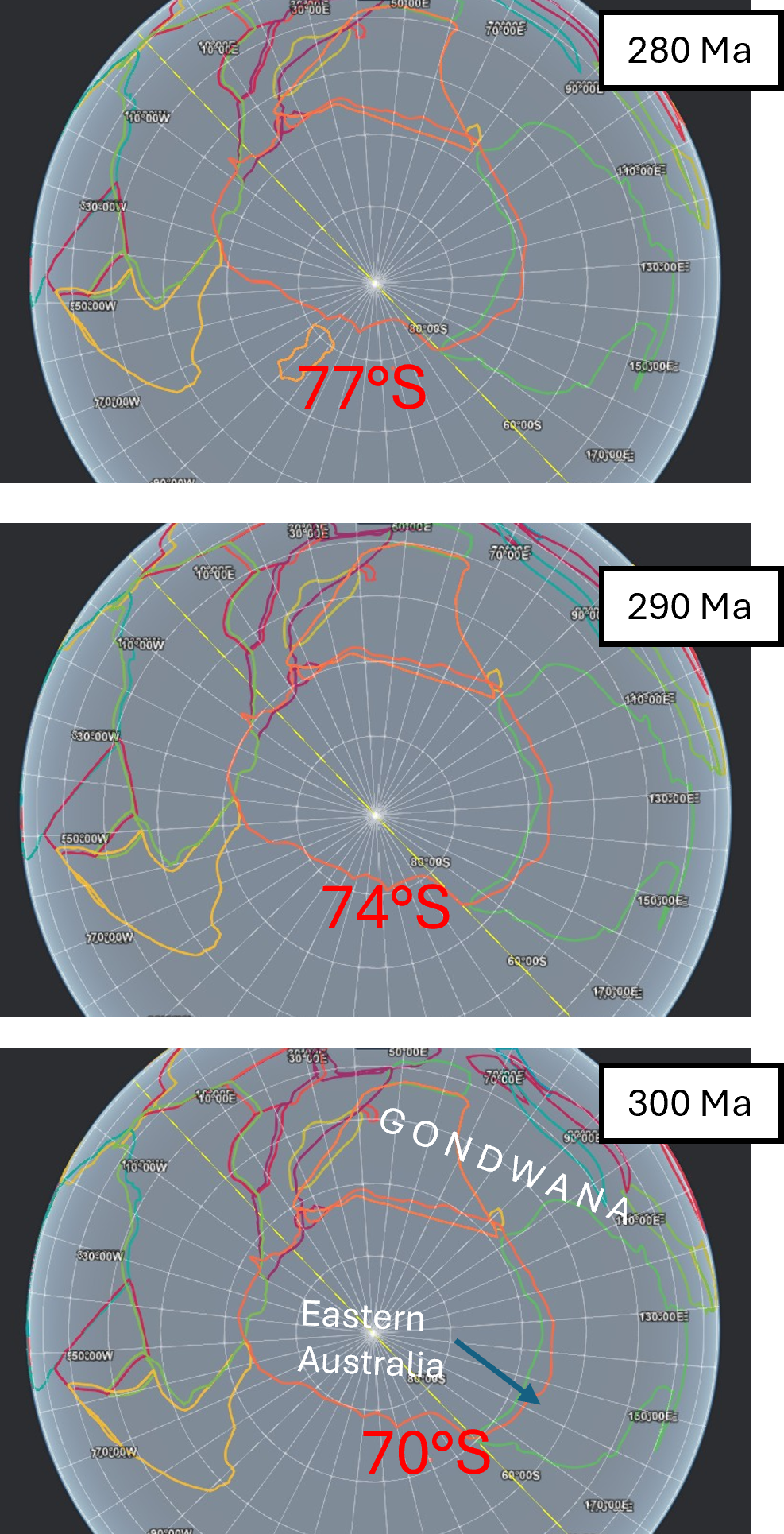
Eastern Australia moved south to higher latitudes, from 70°S to 77°S between 300 Ma and 280Ma
A simple survey of the palynological characteristics of the Early Permian in eastern Australia (e.g. Laurie et al. 2016) indeed suggests that cheilocardioid spores such as Microbaculispora persist much longer into the Early Permian (into the late Artinskian) than in northeast Gondwana where such spores become very rare after the Asselian (Stephenson et al. in review b). It is noteworthy that cheilocardioid spores were produced by plants that are sensitive to temperature rise (e.g. see Stephenson et al. 2026).
The dynamic between temperature rise due to global warming and temperature rise due to continental drift needs careful consideration particularly in correlation and palaeoclimate studies.
References
Jurikova, H., Garbelli, C., Whiteford, R. et al. 2025. Rapid rise in atmospheric CO2 marked the end of the Late Palaeozoic Ice Age. Nat. Geosci. 18, 91–97 https://doi.org/10.1038/s41561-024-01610-2
Laurie, J. R., Bodorkos, S., Nicoll, R. S., Crowley, J. L., Mantle, D. J., Mory, A. J., … Champion, D. C. (2016). Calibrating the middle and late Permian palynostratigraphy of Australia to the geologic time-scale via U–Pb zircon CA-IDTIMS dating. Australian Journal of Earth Sciences, 63(6), 701–730. https://doi.org/10.1080/08120099.2016.1233456
Montañez, I., 2022. Current synthesis of the penultimate icehouse and its imprint on the Upper Devonian through Permian stratigraphic record. In Lucas, S. G., Schneider, J. W., Wang, X. and Nikolaeva, S. (eds) 2022. The Carboniferous Timescale. Geological Society, London, Special Publications, 512, 213–245.
Stephenson, M. H., Shuzhong Shen, S., Junxuan Fan, J., Linshu Hu, L., Jin Qi, J. 2026. Effect of steep climate gradient on palynological assemblages on the Arabian part of the Tethys shore in two Carboniferous-Permian ice age time slices, Review of Palaeobotany and Palynology, Volume 344, 105448, ISSN 0034-6667, https://doi.org/10.1016/j.revpalbo.2025.105448.
Stephenson et al. in review. Palaeotemperature calibration of palynological assemblages through the last stage of the Late Palaeozoic Ice Age in Arabia
Stephenson et al. in review. Palynological zonation for the Carboniferous-Permian of northeastern Gondwana
Mike Stephenson is avalaible for consulting in palynology and stratigraphy